What If Martin Luther Did Not Post His 95 Theses?
October 31, 2025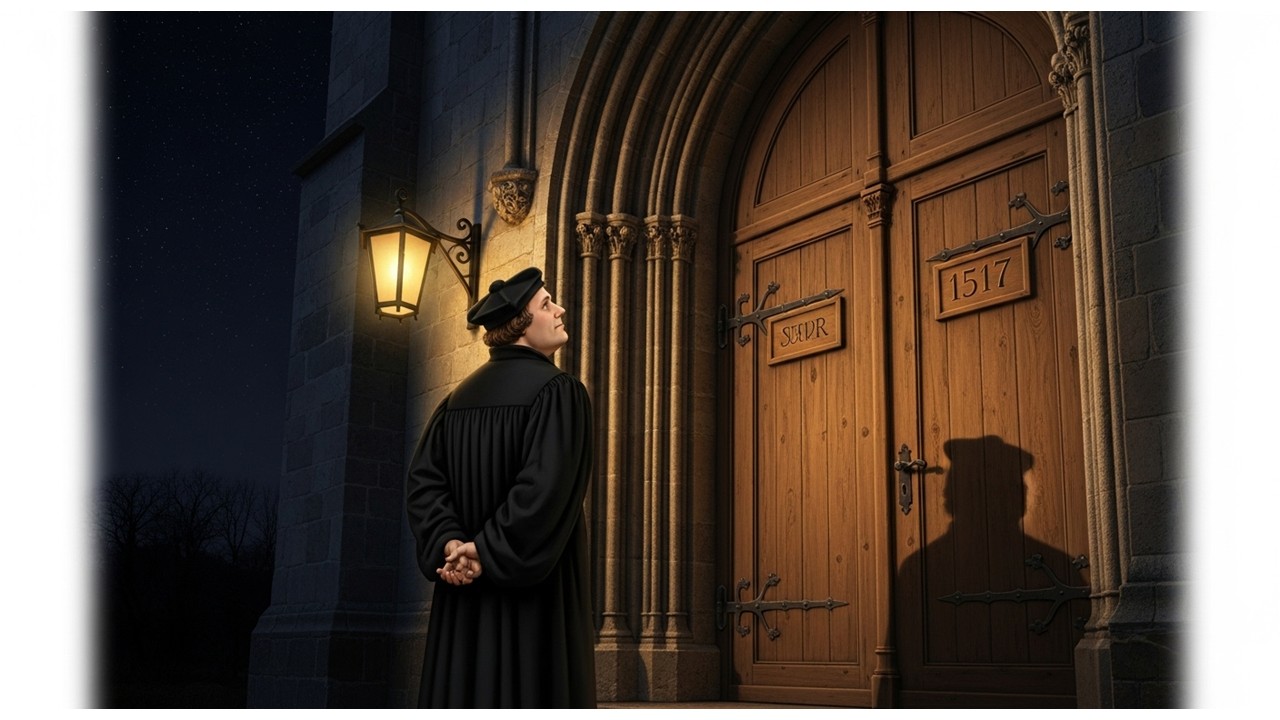
What If Martin Luther Did Not Post His 95 Theses?
A Reflection on the Cost of Silence and the Courage of Truth
Imagine a world where Martin Luther never nailed his 95 Theses to the door of the Wittenberg church.
No hammer striking wood.
No questions raised.
No sparks to ignite the Reformation.
What would Christianity look like?
What would faith look like?
If Luther had remained silent, the gospel would have remained buried beneath centuries of superstition and fear. The Church of Rome would have continued its rule unchecked, chaining the Word of God to the altar of human authority. Forgiveness would still be sold for silver, and salvation would still be measured by penance and pilgrimage. The conscience of man would remain enslaved to the dictates of men rather than freed by the truth of Scripture.
Without Luther’s protest, the just shall live by faith might still be a forgotten phrase—lost in the shadows of Latin liturgies few could understand.
Romans 1:17, the verse that turned the world upside down, might have stayed locked in the pages of a Bible hidden from the people. For it was this truth that shook Luther’s soul:
“The just shall live by faith.”
Though this verse was not written in the 95 Theses, it was the unseen fire behind them. Luther’s rediscovery of this verse revealed the heart of the gospel—salvation not by works, not by indulgences, not by the merit of saints or the intercession of priests, but by faith alone in Christ alone.
If he had not stood upon that truth, the message of justification by faith would have remained buried. We would still be living in the Dark Ages—trusting rituals instead of repentance, ceremonies instead of the cross, religion instead of relationship with the living God. The pulpit would still be silent, replaced by processions and relics. The Bible would remain closed, read only by a privileged few. The people would still live under fear, never certain whether they had done enough to please God.
But Luther did act. And it makes perfect sense that he did.
Because the truth, once seen, demands to be spoken.
Because the gospel, once rediscovered, cannot be hidden again.
Because when a man finds in Scripture that the just shall live by faith, he can no longer live by fear.
Luther’s posting of the 95 Theses was not an act of rebellion—it was an act of reformation. It was the cry of a conscience captive to the Word of God, refusing to be silent while souls perished in error. His hammer struck not merely wood, but the gates of spiritual bondage. The echo of that strike resounded across Europe, breaking chains and opening Bibles, freeing minds and transforming nations.
Had Luther not acted, there would have been no Reformation, no gospel-centered preaching, no revival of biblical truth, and perhaps no freedom of conscience or democracy as we know it. But because he did, the world was changed—not by force, but by the power of the Word.
The question, then, is not only what if Luther did not post his 95 Theses, but what if we remain silent when truth is at stake?
Luther’s courage makes sense because truth demands courage.
It makes sense because error cannot be reformed by comfort.
It makes sense because faith without conviction is no faith at all.
Luther once said, “Here I stand; I can do no other.”
And by standing, he helped the world to see again the blazing light of this eternal truth:
The just shall live by faith.
Write a Comment
Comments for this post have been disabled.